

A home energy assessment tells you how much energy your house uses in a year, where that energy is going, and what it would take to use less. In Ontario, it is carried out by an energy advisor registered with Natural Resources Canada, and it ends with something called an EnerGuide rating: a single number, measured in gigajoules per year, that captures your home’s energy performance.
Here is the part almost nobody explains up front. That number is not your hydro bill. It is a standardized score, closer to a car’s fuel-economy sticker than to a monthly statement, built so any two Ontario homes can be compared on equal footing.
This guide walks through the whole thing in plain language: what an assessment costs in Ontario right now, exactly what happens during the visit, and how to actually read the label and report you walk away with. By the end, you will be able to look at an EnerGuide number and know whether it is good, bad, or about average for a home like yours.
What Is a Home Energy Assessment?
A home energy assessment, also called an EnerGuide evaluation or a home energy audit, is a measured analysis of how your home uses energy. It is carried out by a registered advisor and includes a thorough inspection of your home to identify air leaks and drafts, gaps around doors and windows, indoor air quality, insulation levels, and HVAC equipment.
The assessment is not a guess and it is not a visual once-over. The advisor takes physical measurements, including a blower door test that measures exactly how leaky your home is, and feeds that data into energy modelling software called HOT2000, developed by Natural Resources Canada (NRCan). The software produces your EnerGuide rating along with a detailed report.
One thing to be clear about from the start: a home energy assessment is about energy performance, not structural condition. It will tell you that your attic insulation is underperforming. It will not tell you whether your roof needs replacing. That is a separate job for a home inspector.
How Much Does a Home Energy Assessment Cost in Ontario?
In 2026, a pre-retrofit EnerGuide assessment in Ontario typically runs $400 to $700, with most homeowners landing around $500. If you complete the work and need a follow-up assessment, that one runs $300 to $400.
Price varies with the size and complexity of your home and the service organization you book through. A small bungalow sits at the lower end. A large two-storey with multiple additions sits at the higher end.
Here is the part worth knowing. If you are doing the assessment as part of Ontario’s current Home Renovation Savings Program (HRSP) and you complete eligible upgrades, the final rebate includes a $600 reimbursement to offset the cost of both the initial and final assessment. In that scenario, your net out-of-pocket cost for the assessments may be limited mainly to the follow-up assessment fee, depending on the assessment provider and final rebate amount.
The assessment cost is only “lost” money if you never act on the recommended upgrades.
Program terms change, so always confirm the current offset on the official program page before booking. The value of understanding your home, on the other hand, does not expire.
Not ready to commit to a $500 audit yet? Before you spend $500 on a registered audit, a virtual home energy assessment gives you a fast, low-cost read on where your home likely stands. For many homeowners, this provides a faster first step before a full energy audit. It is not an official EnerGuide assessment, but it helps you decide whether booking one is worth it for your home right now.Try Cobnect
The Home Energy Assessment Process, Step by Step
1. You book through a service organization.
EnerGuide assessments are delivered by service organizations that work with NRCan-registered energy advisors. You choose one, and a representative contacts you to schedule. Be wary of unsolicited door-to-door callers claiming to represent EnerGuide. A legitimate advisor is registered with NRCan and booked through a service organization.
2. You get a pre-visit call.
The advisor confirms what they will need access to and flags anything specific about your home. This is your chance to ask questions before they arrive.
3. You prepare the home.
A little preparation makes the assessment faster and more accurate. Have your municipal property tax roll number ready to confirm ownership. Clear an unobstructed path to your attic, crawl space, and mechanical equipment. If you have a wood-burning appliance, do not use it within 24 hours and remove any ashes, so they are not drawn into the house during the blower door test.
4. The advisor arrives and you sign a consent form.
The energy advisor presents a Notice to Homeowner consent form, reviews the scope and duration, and explains the data collection process. The legal homeowner needs to be present for the assessment. The advisor also takes photos of the home’s exterior, mechanical systems, attic, and any wood-burning appliances, for quality-assurance records.
5. The blower door test runs.
A large fan is mounted in an exterior doorframe and depressurizes the house. This is the measurement that tells the advisor precisely how much air your home leaks. While it runs, the advisor documents insulation levels, windows, and the size and efficiency of your heating, cooling, and water-heating systems.
6. The visit wraps up.
Assessments generally take 2.5 to 3 hours, depending on the size and complexity of the home.
7. Your report arrives.
It can take a minimum of 14 days after the assessment for the advisor to finalize and send your results. You receive three things: your EnerGuide rating and label, a Homeowner Information Sheet explaining how the rating was calculated, and a Renovation Upgrade Report with a customized, prioritized action plan.
That Renovation Upgrade Report is the practical payoff. It does not just tell you your home is inefficient. It tells you which fixes deliver the most energy savings, and in what order to tackle them.
What Your EnerGuide Label Actually Means
This is where most homeowners get lost, because the label has several numbers and the government documentation explains them in technical terms. Here is each one in plain language.
Your EnerGuide rating (GJ/year).
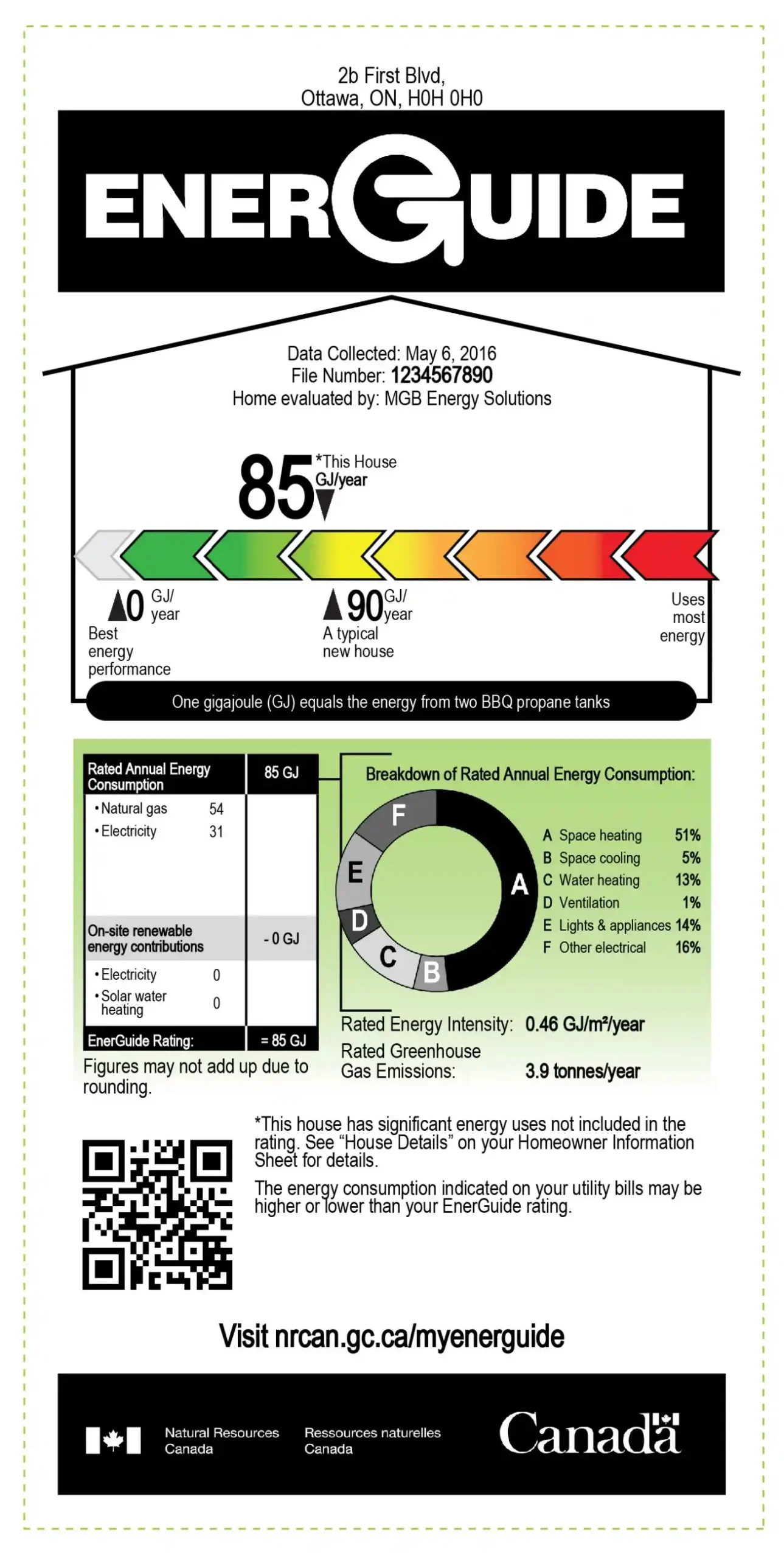
This is the headline number. It is an estimate of the net amount of energy your house consumes in a year, measured in gigajoules per year (GJ/year), shown both as a number and as a point on a scale. Lower is better. A rating of zero means the home produces as much energy as it consumes, a net zero home. One gigajoule is an abstract unit, so for scale: the average Canadian household uses about 100 gigajoules of energy per year.
The reference house.
Beside your rating, the label shows a second number: your home’s “typical new house” rating. This reference point is a version of your house as if it had been built to current new-construction energy standards. Your home may be more or less efficient than that reference. It is generated uniquely for your home, so it is a fair, like-for-like comparison rather than a national average.
The rated energy intensity (GJ/m²/year).
This is the number most people overlook, and it is arguably the most useful one. It expresses energy use per square metre of floor area. Because it adjusts for size, it lets you compare a small home and a large one fairly. A big house will always use more total energy than a small one. Energy intensity tells you how hard each square metre of your home is working, which is the better measure of true efficiency.
The energy use breakdown.
The label includes a breakdown, often a pie chart, of your home’s major energy uses, giving you an at-a-glance view of where you could lower costs. For most older Ontario homes, space heating dominates, which is why insulation and air sealing usually top the upgrade list.
Greenhouse gas emissions.
The label estimates the greenhouse gases your home emits annually from its energy use. This matters more if you heat with natural gas, oil, or propane than if you are on electricity.
A note on old labels.
If you find an EnerGuide label showing a score out of 100, you are looking at the retired system. NRCan retired the 0-100 scale on December 31, 2018, and those ratings cannot be converted to the current GJ/year figure because the new system measures different things. If your home has an old label, it needs a fresh assessment to get a current rating.
What’s a Good EnerGuide Rating for an Ontario Home?
This is the question the official pages never answer directly. So here is a straight, Ontario-specific answer.
For a typical Ontario home, the rough benchmarks look like this. An older Ontario home usually rates somewhere around 100 to 180 GJ/year. A home built to current code rates
closer to 70 to 100 GJ/year. A high-performance home, one that is well insulated, air sealed, and running efficient mechanicals, can come in below 60 GJ/year.
So if your assessment comes back at 150 GJ/year, you are not broken, you are a normal older Ontario house with real room to improve. If it comes back at 80, you are roughly where a new build sits. If it comes back under 60, your home is performing well above average.
Two important caveats. First, these are ranges, not pass-or-fail lines. A larger home will naturally post a higher total even when it is efficient, which is exactly why the energy intensity number matters. Second, the rating reflects the house, not how you live in it.
Why Your EnerGuide Rating Is Not Your Hydro Bill
This trips up almost everyone, so it is worth stating plainly. Your EnerGuide rating does not reflect your actual utility bill. It is based on standardized operating conditions, set assumptions for thermostat settings, hot water use, occupancy, and appliance loads.
That is a feature, not a flaw. By holding behaviour constant, the rating isolates the performance of the building itself. If the rating reflected real bills, a frugal family in a leaky house could “outscore” a large family in an efficient one, and the number would tell you nothing about the house. NRCan deliberately focuses on the home’s energy performance, not occupant behaviour, so a rating can accurately compare energy use between one home and another.
The practical takeaway: use your EnerGuide rating to judge your home and to compare it to others. Use your utility bills to judge your habits. They answer different questions.
Curious where your home likely falls on that scale? Cobnect Lens estimates your home’s likely energy performance range from details you already know, no site visit required. It is a quick, informational starting point, not an official rating, but it helps you decide whether a full EnerGuide assessment is your next step. Estimate my home’s range.
What to Do With Your Results
An assessment is only worth the money if you act on it. Once you have your report:
Start with the Renovation Upgrade Report’s top recommendations. They are ranked by impact, and for most Ontario homes the sequence runs air sealing and insulation first, then mechanical systems like a heat pump, because there is no sense oversizing equipment to heat air that is leaking straight out.
If rebates matter to you, check the current Home Renovation Savings Program rules before you start any work. The order of operations is strict, and doing the work before the pre-assessment can disqualify you.
And keep the label. It is an official record of your home’s energy performance and may help support resale value, particularly as energy performance increasingly shows up in Ontario real estate conversations.
The Bottom Line
A home energy assessment turns a vague worry about heating costs into specific, ranked, actionable information. In Ontario it costs around $500, takes about three hours of your time, and a meaningful chunk of that cost can come back to you if you complete eligible upgrades under the current rebate program.
The EnerGuide rating it produces is not a grade and it is not your hydro bill. It is a standardized measure of how your home performs, designed so you can compare it fairly to a new build, to a high-performance home, or to the place down the street. Once you can read it, you stop guessing about your home and start making decisions with actual numbers behind them.
If you are not ready to book a registered advisor yet, the lowest-friction first move is a virtual estimate of where your home likely stands. It costs little, takes minutes, and usually makes the decision about a full assessment obvious.
