

Most Canadian homeowners have never heard the term “virtual home energy assessment” until someone offers them one. Then the questions start. Is this actually accurate? What does it measure? Is it the same as an energy audit? Can I trust it?
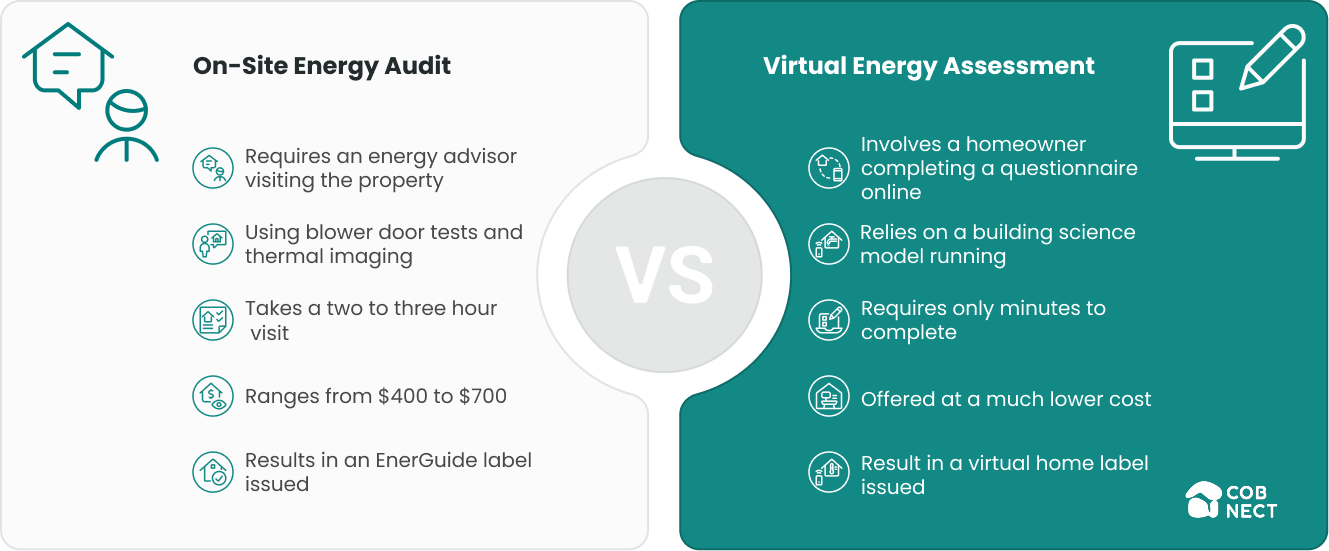
Those are reasonable questions. The on-site home energy audit has been the standard in Canada for decades, carried out by NRCan-registered Energy Advisors who visit your home with specialized equipment and spend two to three hours inspecting everything from your attic insulation to your basement air sealing. It is thorough, credible, and the basis for most major retrofit rebate programs.
Virtual assessments work differently. No advisor visit, no scheduling delay, no blower door machine in your living room. In many cases the assessment is complete in minutes on your phone or laptop. That convenience is real. So is the skepticism. The honest answer to “can I trust a virtual assessment?” depends heavily on how that assessment was built, what it actually models, and whether the result reflects the physics of your home or just a set of statistical averages.
This article explains what virtual assessments are, how they estimate where your home loses energy, how they stack up against an on-site audit, and how to tell a credible one from a number pulled out of thin air. Canada’s energy labelling rules are part of that story, and they arrived in a meaningful new form in 2026, but the more useful starting point is the building science underneath, because that is what determines whether any assessment, virtual or on-site, is worth trusting.
What Is a Virtual Home Energy Assessment?
A virtual home energy assessment (sometimes called a virtual energy audit or a digital home energy assessment) estimates a home’s energy performance without a physical site visit. Instead of an energy advisor arriving at your door with a blower door machine and a thermal camera, the assessment uses data inputs, building science models, and in some cases machine learning, to estimate how your home uses energy, where it loses it, and what improving it might look like.
The outputs typically include an estimate of your home’s annual energy consumption (measured in gigajoules per year), estimated greenhouse gas emissions (in tonnes of CO2 equivalent per year), and estimated annual energy costs. A well-built virtual assessment will also surface the specific areas where your home is likely underperforming, such as an under-insulated attic or an aging natural gas furnace, and provide ranked retrofit recommendations.
What a virtual assessment does not do is produce an official EnerGuide label. EnerGuide is a federal program administered by NRCan through certified Energy Advisors who conduct on-site evaluations using HOT2000, the government’s building simulation software. Virtual assessments are a separate category. If a tool implies you will receive an official EnerGuide rating, that is a significant credibility problem. Credible providers are explicit about what their output is and what it is not.
How Does a Virtual Assessment Actually Work?
The mechanics vary by provider, but quality virtual assessments share a common process. They collect a defined set of inputs about your home, run those inputs through a building energy model, and generate outputs that describe your home’s estimated energy performance.
The data inputs are where most virtual assessments quietly fall apart. Every home’s energy behaviour comes down to the interaction of three systems: the structure (how big it is, how it is shaped, when it was built), the envelope (the walls, roof, windows, and foundation that separate inside from outside), and the mechanicals (how it heats, cools, and makes hot water). Miss or guess at any one of those and the model drifts. A credible assessment gathers enough across all three to capture how the home actually loses and uses energy in a Canadian climate. Collecting that information is the easy part. The hard part is what happens next.
The difference between a weak tool and a rigorous one is not the length of the questionnaire. It is how the assessment handles the gaps, the inference, and the uncertainty. Real homes rarely arrive with every detail perfectly known. A homeowner may not know their foundation type or the exact age of their furnace. A serious modelling engine does not simply leave those fields blank or substitute a national average. It infers the most probable values from everything else it knows about the home, and produces a result that reflects both the estimate and the uncertainty around it. That inference layer, built on real home evaluations, is what separates an actual energy model from a glorified calculator.
The Building Science Underneath: Where Homes Actually Lose Energy
To understand what a virtual assessment is estimating, it helps to understand how a house loses energy in the first place. This is settled building science, and it is the foundation every credible energy model is built on.
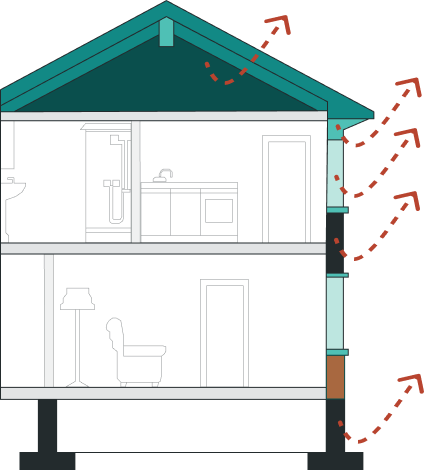
Heat moves through a home by three mechanisms of heat flow: conduction through solid materials like walls and windows, convection as air carries heat from one place to another, and radiation. In a typical home, a large share of all energy consumed goes toward heating and cooling, and air leakage combined with too little or poorly installed insulation accounts for much of that waste. Those two factors, the envelope’s insulation and its airtightness, are where most of the opportunity sits.
Insulation works by trapping pockets of still air to slow heat transfer, and its effectiveness is measured by R-value: the higher the R-value, the more slowly heat passes through. But here is a detail most homeowners never hear. The real-world performance of insulation is often lower than its rated value, because gaps, voids, and compression during installation create paths for heat to bypass it. A nominally well-insulated attic with poor installation can underperform a modestly insulated one done right.
Air leakage is the second half of the story. Air naturally moves from higher pressure to lower pressure through the easiest available path, usually a crack or gap in the building envelope. Every cubic metre of warm air that escapes in winter is replaced by cold air the heating system then has to warm. This is why airtightness is so central to energy performance, and why an on-site audit uses a blower door test, which depressurizes the house to measure exactly how leaky it is, expressed as air changes per hour at 50 pascals of pressure (ACH50). A virtual assessment cannot run a blower door test. What a strong model can do is estimate a home’s likely air leakage from its age, construction type, and known characteristics, then be honest about the confidence range on that estimate.
This is the knowledge a virtual model encodes. When it tells you your attic is the priority, it is because the physics of heat flow through an under-insulated ceiling, combined with what it knows about homes like yours, point there first.
How Canada’s New Standards Fit In
Until recently, anyone could call their product a “virtual home energy assessment” with no shared reference point to measure quality against. That changed in 2026. Natural Resources Canada published its Guidelines for Virtual Home Labelling in 2026, the most concrete output yet of the National Approach to Home Labelling, a federal initiative backed by a $30 million commitment in Budget 2024 to bring consistency to home energy labelling across the country. Developed with input from nine virtual home labelling companies and eleven provincial and municipal governments, the framework defines what a credible virtual assessment should collect, how it should model a home, and how results should be reported, so that two assessments of the same house can be meaningfully compared.
A few principles from that framework are worth knowing as a homeowner. Quality assessments should be asset-based, so results describe the house and not its current occupants. They should report performance in consistent units, the way a nutrition label uses standard measures, so you can compare one home to another. And providers should be clear that a virtual assessment is its own category, not a substitute for an official on-site EnerGuide evaluation.
Cobnect modelling engine (Cobnect Lens) is built in alignment with this framework. Its asset-based modelling approach and its reporting format map to what the guidelines define as the standard for quality. The deeper work, the inference engine that fills gaps intelligently and the confidence weighting that makes each result defensible, is where Cobnect’s modelling was purpose-built for the Canadian housing stock rather than adapted from a generic energy calculator.
The outputs of a quality assessment are reported in three figures: annual energy use in gigajoules per year (GJ/yr), greenhouse gas emissions in tonnes of CO2 equivalent per year, and estimated annual energy costs. The GJ/yr figure is the same metric Canada’s official EnerGuide Rating System has used for existing homes since it moved to a consumption-based scale, effective January 1, 2019. Lower numbers mean a more efficient home.
The Three Tiers of Virtual Assessment Quality
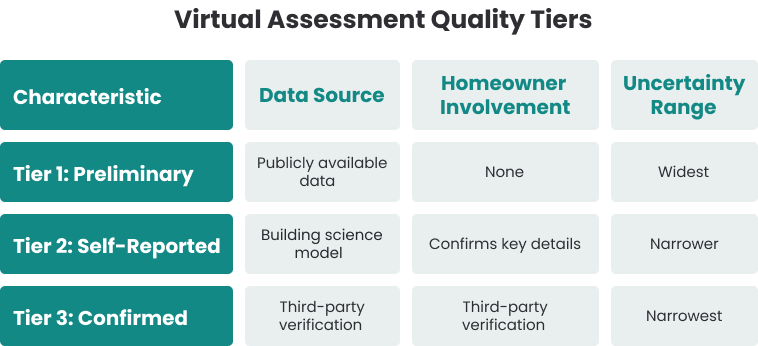
Not all virtual assessments are equal, and the honest way to think about quality is by how much the data behind the result has actually been verified. There are broadly three levels, each with a tighter confidence range than the last.
The first tier is a preliminary assessment. This uses inferred or publicly available data, such as property assessment records, building permit data, or municipal databases, without direct homeowner confirmation. It can give a useful directional picture of a home’s energy performance at a neighbourhood or portfolio scale. The uncertainty in the output is the widest of the three tiers, but for a homeowner just beginning to think about their home’s efficiency, it is a legitimate starting point.
The second tier is a self-reported assessment. This is the tier that homeowner-facing tools like Cobnect operate within, and it is where the combination of solid building science modelling and homeowner-confirmed inputs produces results that are genuinely decision-useful. The homeowner verifies the key details about their home, and a credible provider treats that confirmation step seriously before any result is finalized. That single step, a human who lives in the home checking the assumptions, is what separates a self-reported result from a purely inferred one, and it meaningfully tightens the accuracy range.
The third tier is a confirmed assessment, where a third party, whether a home inspector, appraiser, or other trained professional, verifies the key inputs without needing to conduct a full on-site EnerGuide evaluation. This produces the narrowest uncertainty range of any virtual method while still avoiding a full site visit.
For most homeowners, the self-reported tier is the right entry point. It is fast, it is substantively accurate when built on good inputs and a solid building science model, and it surfaces retrofit opportunities most homeowners have never had visibility into.
Virtual Assessment vs. On-Site Energy Audit: When You Need Which
This is the question most homeowners eventually ask, and it deserves a clear answer.
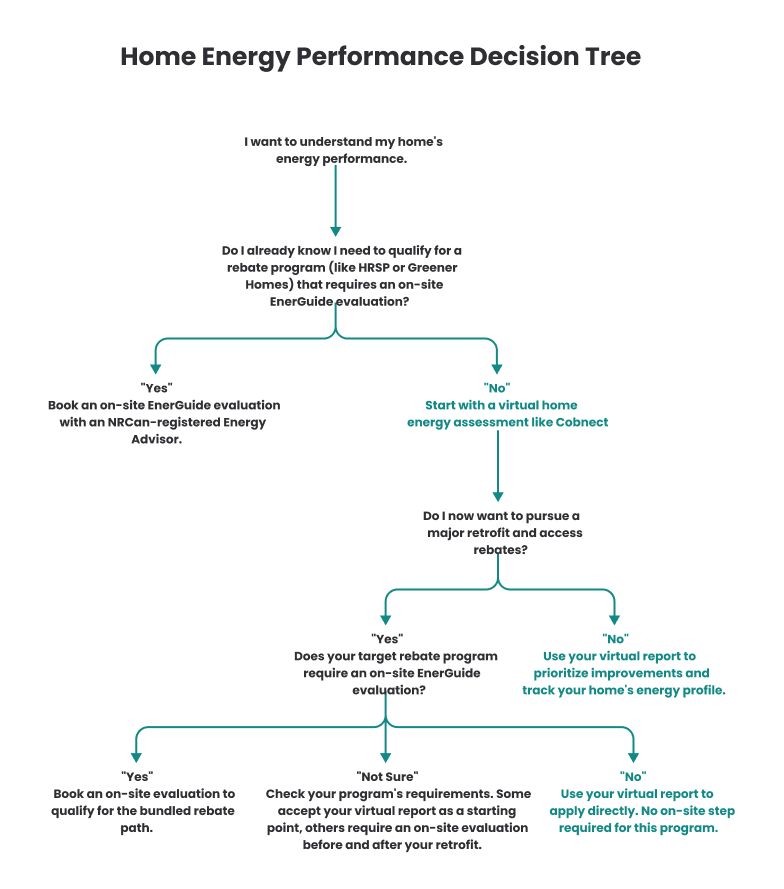
An on-site EnerGuide evaluation remains the right tool when you want to qualify for rebate programs that require one, when you need a legally recognized energy rating for your home, or when you are planning a complex multi-system retrofit and want the highest possible confidence in your baseline. In Ontario, the Home Renovation Savings Program (HRSP), delivered through Enbridge Gas and Save on Energy, requires an on-site assessment for its bundled rebate path, though many upgrades are available without one. Apre-retrofit EnerGuide audit in Ontario typically costs $400 to $700, with the post-retrofit follow-up running an additional $300 to $400, and wait times for a registered Energy Advisor can stretch several weeks depending on your region.
A virtual assessment is the right starting point when you want to understand your home’s energy performance before committing to anything, when you are buying or selling a home and want a fast, informed picture of its efficiency profile, when you are a professional (a realtor, home inspector, or mortgage advisor) who needs to communicate energy context quickly, or when you simply want to know where your retrofit dollars would have the most impact before booking an expensive advisor visit.
The two tools are not substitutes. Think of a virtual assessment as a well-informed first opinion and the on-site audit as the specialist referral.
See how your home measures up against Canada’s new standards You now know what separates a credible virtual assessment from a guess. The fastest way to see it in practice is on your own home.
See your home’s estimated energy performance with Cobnect Aligned with NRCan’s 2026 guidelines for virtual home labelling.
What to Look For in a Virtual Assessment Provider
The virtual assessment market in Canada grew faster than the standards that should govern it. That is changing with Canada’s 2026 framework, but homeowners still need a practical checklist for evaluating what they are being offered.
Does it model the full home, or just the obvious parts?
A tool that asks four or five questions and returns a number is guessing. A home’s energy behaviour comes from the interaction of its structure, its envelope, and its mechanical systems, not from square footage alone. The more revealing question is what the tool does when something is unknown. A credible assessment infers missing values intelligently and tells you how confident it is. A weak one silently fills the gap with a national average and presents the result as if it were certain.
Does it use asset-based modelling?
Ask whether the tool models what your house physically is or whether it just extrapolates from your utility bills. Bill-based estimates blend the house with the behaviour of whoever currently lives there. Asset-based modelling describes the home itself, which makes the result transferable when you sell and comparable against other homes.
Does it report in the right units?
Quality outputs are expressed in gigajoules per year for energy use, tonnes of CO2 equivalent per year for emissions, and dollars per year for cost. If a tool hands you a score out of 100, it is using the EnerGuide scale that Canada retired at the end of 2018, and its outputs will not line up with the current rating system.
Is it honest about what it is?
No credible virtual assessment claims to produce an official EnerGuide label or to replace an on-site evaluation. Canada’s 2026 guidelines are explicit on this: virtual assessments are their own category and must not be presented as equivalent to an on-site EnerGuide audit. A provider that blurs that line is one to be cautious of.
Is it built on real Canadian data, and are its numbers actually highly accurate?
A model is only as good as what it learned from. Tools validated against hundreds of thousands of actual Canadian home evaluations can be checked against real building performance rather than textbook assumptions. That grounding matters, but it’s worth asking one more question:
how does the provider measure their own accuracy?
A credible tool will have internal validation metrics, error rates, and an honest account of where the model is confident and where it has more uncertainty. A tool that never mentions accuracy is one that probably hasn’t measured it.
Are the retrofit recommendations specific to your home or just generic advice?
This is the question that separates a useful assessment from a dressed-up checklist. Generic and obvious recommendations tell you nothing that you couldn’t have found on a government website. A serious tool produces ranked recommendations based on your home’s specific heat loss profile, heating system, and climate zone. The difference is between being told what most homes need and being shown what your home needs, and why that upgrade comes first.
What a High-Quality Virtual Assessment Report Actually Tells You
When a virtual assessment is built correctly, the report you receive is more informative than most homeowners expect.
At the top level, you will see your home’s estimated annual energy consumption in GJ/yr. Canada’s buildings sector accounts for 18% of the country’s GHG output, and more than 96% of buildings’ operating emissions come from space and water heating. That context matters: your home’s consumption figure places you on a real national spectrum, not a proprietary scoring system.
Below the headline figure, a good report breaks down energy use by system: space heating, water heating, cooling, lighting, and appliances. These differences directly affect the operating cost of a home, which is why two similarly priced houses can produce very different monthly bills. In Canada’s residential sector, space heating accounts for roughly 63% of home energy use, water heating for 15%, and cooling for 3%, with the remainder in lighting and appliances. Understanding your breakdown tells you where the leverage is. An older natural gas furnace in a poorly air-sealed house is a different problem than a well-insulated house with an outdated water heater.
The retrofit recommendations section is where a virtual assessment earns its keep for most homeowners. Ranked by estimated energy impact, these recommendations tell you which upgrades move the needle most for your specific home, not for a generic Canadian house. A few things to watch for when reading any retrofit report: cost estimates that bear no relationship to what contractors in your region are actually quoting, payback periods calculated on energy prices from two years ago, and rebate recommendations that reference programs which have since closed. These aren’t edge cases. They’re common failure modes of tools that generate recommendations from a static template rather than from your home’s actual numbers and the current program landscape. A report that tells you the Canada Greener Homes Grant will cover part of your upgrade cost is not a current report, regardless of when it was generated.
Why This Matters Now: Canada’s Home Labelling Moment
Canada is in an early but deliberate transition toward widespread home energy labelling. Budget 2024 committed $30 million over five years to the National Approach to Home Labelling with an explicit goal: give every Canadian homeowner information about how their home uses energy and what improving it would look like The 2026 guidelines are the most concrete output of that initiative to date, and their arrival is already reshaping how the sector operates.
For municipalities and utilities, the guidelines provide evaluation criteria they can use when procuring virtual assessment providers with confidence. Programs looking to scale virtual home labelling can now specify that providers must align with the framework, covering modelling methodology, output units, and label format. That is a significant shift from the previous situation, where every procurement decision required custom due diligence with no shared reference point. For mortgage lenders and insurers beginning to integrate energy performance into underwriting, the guidelines establish a common language for what a virtual assessment result actually means and how far it can be relied upon. For retrofit contractors and energy advisors, they clarify when a virtual assessment is a useful intake tool versus when an on-site evaluation is the appropriate next step.
For real estate professionals, virtual assessments are a practical tool for adding energy context to a listing or a buyer’s due diligence process without requiring the scheduling and cost of a full on-site audit. For home inspectors, they offer a complementary data layer that extends the scope of a report. For homeowners who simply want to know what their house is doing before committing to a renovation, they are the fastest on-ramp to an informed decision.
Canada is not standing still on this either. NRCan’s 2026-27 departmental plan signals further development: the department is working with the Canadian Standards Association to develop new guidance for AI-based home energy tools. Providers who build on recognized data standards and validated models today are the ones who will be most compatible with tomorrow’s requirements.
The Bottom Line
A virtual home energy assessment, built properly, is one of the most useful tools a Canadian homeowner can reach for before committing to a retrofit. “Built properly” has two parts. First, it rests on sound building science: an honest model of how heat moves through your specific home and where it escapes. Second, it now has a national reference point, since Canada’s 2026 framework gave the sector a shared definition of what quality looks like, from how a home is modelled to how results are reported. A good assessment satisfies both the physics and the standard.
A virtual assessment is not an official EnerGuide label, but a rigorous one is a genuinely useful starting point. It tells you where your home stands, where it loses energy, and which retrofits would make the biggest difference. If you subsequently pursue a major upgrade and want to access programs like Ontario’s Home Renovation Savings Program, an on-site EnerGuide evaluation will still be the required next step for the bundled rebate path.
The more useful frame is that virtual assessments and on-site audits serve different moments in a homeowner’s decision process. One orients you. The other qualifies you. Knowing which you need, and what quality looks like in each case, is what puts you in control of the decision.
See your Ontario home’s energy profile If you want to know where your home actually stands before you spend a dollar on retrofits, this is the fastest place to start.
Start your Cobnect assessment Built on real audit records and aligned with NRCan’s 2026 guidelines. No site visit required to start.
